
By Fran Leavy, Couples Counsellor at Summit Counselling and Psychotherapy Swords
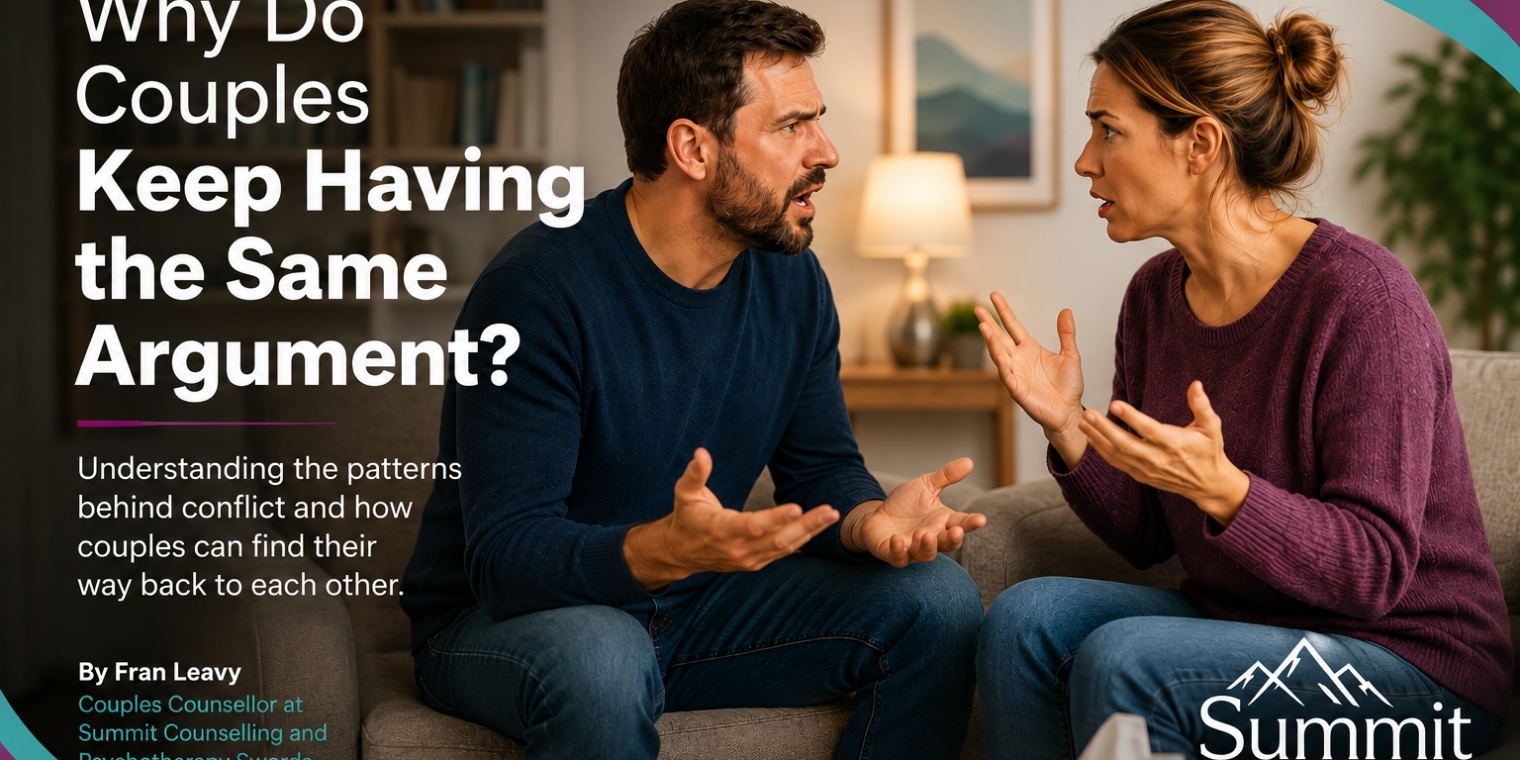
Have you ever finished an argument with your partner and wondered, How did we end up here again?
It might start with something small. Someone forgot to do something around the house. One person was late. A comment was made about money, the children, work, sex, or whose turn it was to empty the dishwasher.
Ten minutes later, you are no longer arguing about the dishwasher.
You are talking about something that happened three years ago.
One of you feels criticised. The other feels ignored. Voices get louder, someone shuts down, and eventually you both walk away feeling misunderstood, hurt or disconnected.
Then, a few days later, it happens again.
For many couples, the problem isn’t that they argue. It is the way they argue and what happens between them when they do.
And if this sounds familiar, it doesn’t necessarily mean there is something fundamentally wrong with your relationship. Often, it means you have both become caught in a pattern that neither of you quite knows how to get out of.
The encouraging thing is that patterns can be understood. And when they are understood, they can begin to change.
Couples argue differently
When I work with couples, I don’t expect them to agree on everything.
Two people can love each other deeply and still see the same situation very differently. You bring different personalities, families, experiences, expectations and ways of communicating into a relationship.
Disagreement is inevitable.
What becomes important is understanding what happens between you when that disagreement begins.
Some people want to deal with a problem immediately.
“We need to talk about this.”
Their partner might need space.
“I can’t talk about this right now.”
The first person can experience that as rejection or avoidance, so they push harder to get a response.
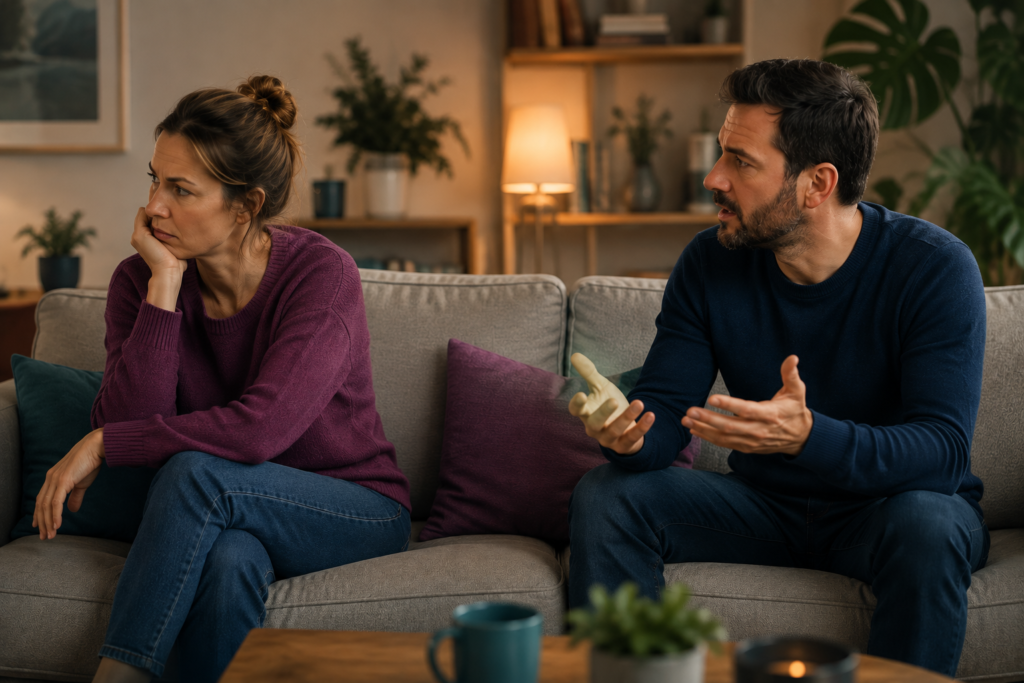
The second person feels increasingly overwhelmed, so they withdraw even further.
Suddenly, both people are reacting to each other’s reactions.
The more one pursues, the more the other withdraws. The more one withdraws, the more the other pursues.
Neither person necessarily wants an argument. Often, both are trying in their own way to protect themselves or the relationship. But together they have fallen into a pattern.
Seeing the pattern can be an important first step, because instead of viewing your partner as the problem, you can begin to recognise the cycle that you have both become caught in.

What are you really arguing about?
Sometimes the subject of an argument isn’t the real issue.
Imagine one partner says:
“You’re always on your phone.”
On the surface, the argument is about a phone.
Underneath it might be:
“I miss you.”
“I don’t feel important to you.”
“I want to feel like you actually want to spend time with me.”
The response might be:
“I’m allowed to relax. You’re always criticising me.”
Underneath that could be:
“I feel like whatever I do isn’t good enough.”
“I don’t feel appreciated.”
“I feel like I’m constantly getting things wrong.”
Now we have a very different conversation.
Instead of two people fighting about a phone, we begin to see two people who may both be longing to feel valued, appreciated and connected.
This is often where couples counselling can help. Instead of simply deciding who was right about the phone, we can begin to understand what is happening underneath the argument for both people.
Sometimes, when couples begin to hear what is underneath the words, they can start to see each other differently too.

When criticism becomes personal
There is an important difference between complaining about something that happened and attacking your partner as a person.
“I was frustrated that you didn’t tell me you were going to be late” is very different from:
“You never think about anyone except yourself.”
Words such as always and never can quickly turn a disagreement into something much bigger.
When we feel attacked, our natural response is often to defend ourselves.
“That’s not true.”
“What about when you did…?”
“You’re just as bad.”
The original issue can quickly disappear as both partners try to prove their case.
Nobody feels heard because both people are preparing their defence.
Changing this doesn’t mean never getting angry or frustrated. It can mean learning to talk about the hurt or disappointment without turning your partner into the enemy.
That takes practice, particularly when you have been communicating in the same way for a long time. But small changes in how a conversation begins can sometimes lead to very different endings.
Why do we keep bringing up old arguments?
One of the most common frustrations I hear from couples is:
“Why do you keep bringing that up? We dealt with that years ago.”
But did you?
Sometimes when something from the past keeps appearing in arguments, it isn’t because your partner wants to punish you or win the argument. It may be because something about that experience has never really felt heard, understood or resolved.
If I tell you that something hurt me and your response is to defend yourself, explain why I shouldn’t feel that way, or tell me what I did wrong too, I might eventually stop talking about it.
But that doesn’t necessarily mean it has gone away.
So it comes back.
It might appear in the next argument, or six months later when something similar happens. From the other partner’s perspective, it can feel like, “Here we go again.” But for the person bringing it up, it can feel like, “You still don’t understand why this mattered to me.”
Sometimes couples become stuck trying to agree on exactly what happened. But you don’t necessarily have to agree with your partner’s version of events to understand the impact the experience had on them.
Being genuinely heard can change a conversation.
“I can understand why that hurt you.”
“I didn’t realise you were still carrying that.”
“I can see why what happened then makes this difficult for you now.”
These can seem like simple words, but being understood by the person we love can be powerful.
When something has genuinely been heard and understood, there may be less need to keep fighting for it to be recognised.
Sometimes the past keeps coming into the present because it is still asking to be heard. And sometimes, when it is finally heard with care and openness, a couple can begin to move forward together.
Sometimes we become overwhelmed
Arguments are not just conversations. Our bodies are involved too.
You might notice your heart beating faster, your muscles tightening or your thoughts racing. You may become angry, defensive or desperate to get your point across.
Another person might become quiet, struggle to think clearly or want to leave the room.
At that point, continuing the conversation may not actually help.
Taking a break doesn’t have to mean avoiding the issue or abandoning your partner. Sometimes it is one of the kindest things you can do for the conversation, allowing both people to settle before trying again.
The important part is returning to it.
“I need some time to calm down. Can we come back to this later tonight?”
That feels very different from walking away without saying anything.
It communicates: This conversation matters to me, and so do you. I just need a little time before I can talk about it properly.

Learning to argue better
A healthy relationship isn’t necessarily one without arguments.
It is one where disagreement doesn’t automatically become an attack on the relationship, and where both people can gradually learn how to find their way back to each other after things become difficult.
That might mean learning to raise concerns more gently, listening before defending yourself, recognising when either of you is becoming overwhelmed, or becoming curious about what your partner is actually trying to communicate.
Sometimes it can be as simple as replacing:
“Why are you always like this?”
with:
“Can you help me understand what’s happening for you?”
That doesn’t guarantee agreement.
But it creates the possibility of understanding.
Couples can spend years repeating the same argument and begin to believe that nothing will ever change. But often the repeated argument isn’t evidence that the relationship is beyond repair. It is a sign that there is something important between you that you haven’t yet found a way to talk about safely.
When couples begin to recognise the pattern rather than blame each other, listen for what is underneath the argument, and respond with a little more curiosity and compassion, something can begin to shift.
Not overnight, and not perfectly.
But one conversation at a time.
And sometimes that is where a very different conversation and a more hopeful way forward together begins.
Couples counselling in Swords
Fran Leavy has been practising as a counsellor for 15 years and specialises in couples counselling. His work is grounded in a Person-Centred approach, creating a space where both partners can explore their experiences without judgement.
Fran believes that couples are the experts in their own relationships. He works alongside them to understand recurring patterns, improve how difficult conversations are handled and help partners become less stuck in the same arguments. Where appropriate, Fran also draws on Gottman, CBT and psychodynamic frameworks.
Fran works with couples from Summit Counselling and Psychotherapy in Swords, Co. Dublin.
If you and your partner keep finding yourselves having the same arguments and would like some help understanding what is happening between you, you can contact Summit to arrange a couples counselling assessment.