
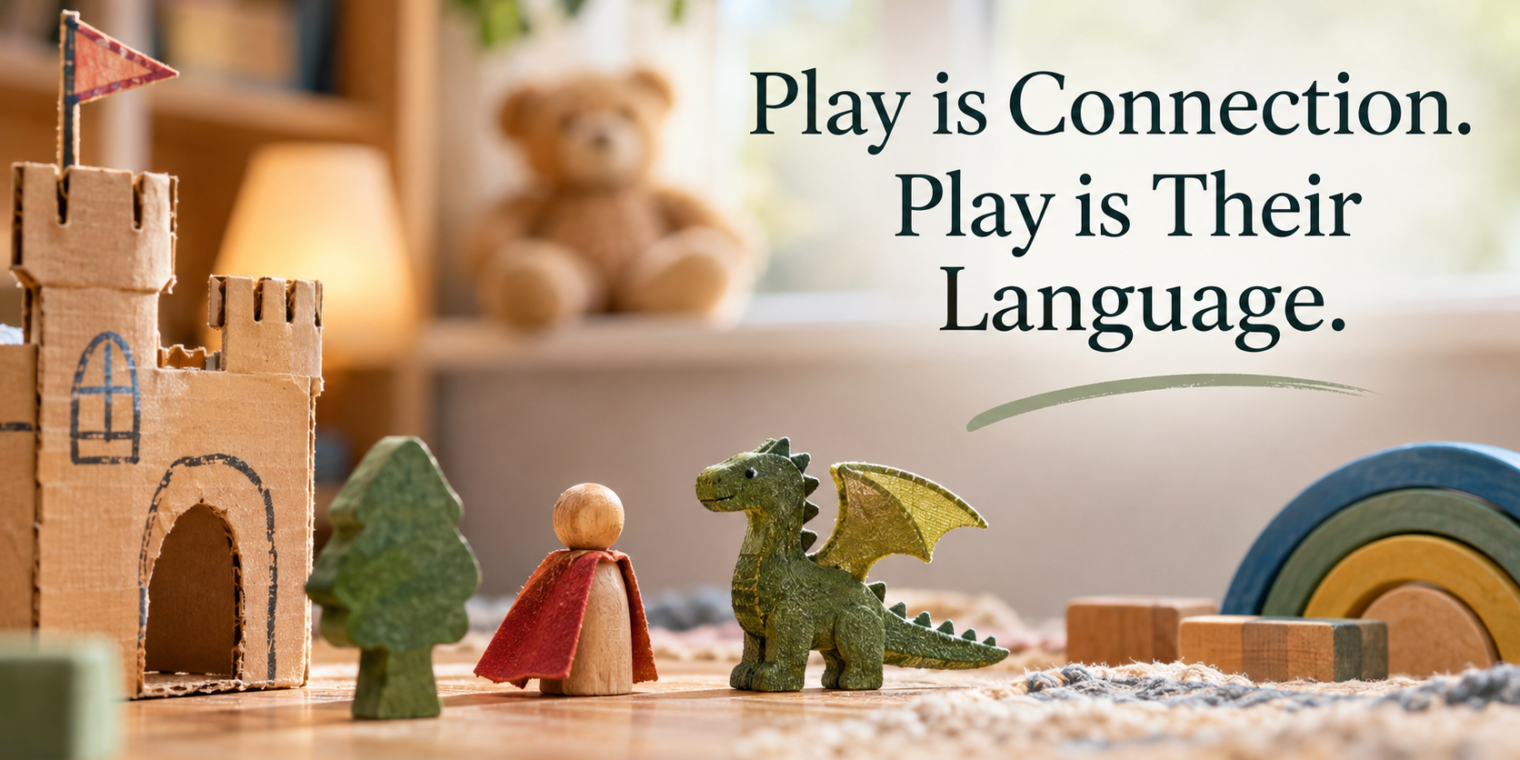
We spend so much time encouraging children to talk about their feelings. But what if we’ve overlooked one of the most natural ways they communicate?
“How was school?”
“Fine.”
“Did anything happen today?”
“No.”
“Are you okay?”
“Yeah.”
Most parents will recognise some version of this conversation. We want to know what’s going on in our children’s lives, particularly when we sense that something isn’t quite right. We ask questions, offer reassurance and try to encourage them to open up.
But children don’t always have the words to explain what they’re experiencing. They may feel anxious without understanding why, angry without knowing what they’re angry about, or unsettled by something they haven’t yet been able to make sense of.
We often expect children to communicate in ways that make sense to us as adults. We rely on language, explanation and conversation. Yet for children, particularly younger children, play is often a much more natural form of expression.
And perhaps this is something we’ve lost sight of.
We recognise play as important for learning, creativity and social development, but we don’t always appreciate its emotional significance. Through play, children explore relationships, experiment with different roles, revisit experiences and make sense of the world around them.
What looks like an ordinary game may be an opportunity to explore feelings or situations that are difficult to understand in everyday life.
This is one of the ideas at the heart of play therapy: play is not simply something children do. It is also one of the ways they communicate.
When feelings don't have words
Think about how difficult it can be, even as an adult, to explain something that’s troubling you.
Sometimes we know we’re upset but can’t quite put our finger on why. We might feel frustrated, overwhelmed or anxious without immediately understanding what’s underneath those feelings.
Now imagine trying to make sense of those experiences without the emotional vocabulary or understanding we’ve developed over years.
Children are still learning to recognise their feelings, understand where they come from and communicate them to others.
When something is difficult, it may show up through behaviour rather than conversation.
We might notice changes in sleep, increased frustration, separation anxiety, withdrawal or difficulties at school. Naturally, as parents, we want to understand what’s happening and help things improve.
But focusing only on the behaviour can sometimes mean overlooking the emotional experience behind it.
Play offers another way of exploring that experience.
A child might repeatedly create stories involving danger and rescue, build elaborate worlds where they control what happens, or explore relationships through dolls, figures and imaginary characters.
We need to be careful not to attach meanings to these stories too quickly. A dinosaur isn’t necessarily a symbol of fear, and a child playing with fighting figures isn’t automatically expressing anger.
But play gives children opportunities to explore emotions, relationships and experiences without needing to explain them directly.
And that can be particularly important when the feelings themselves are confusing.
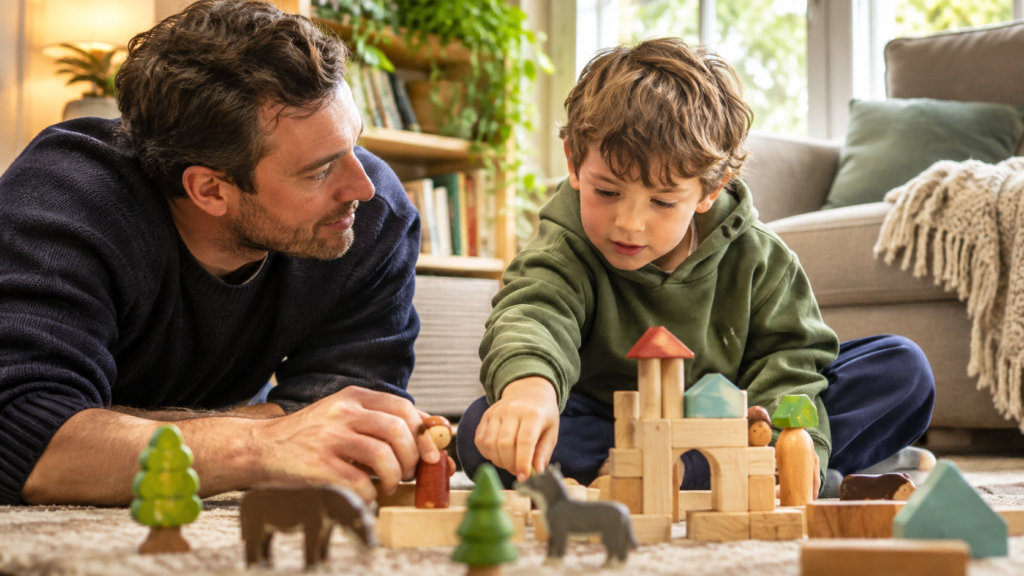
What Virginia Axline understood about children
Virginia Axline, a pioneer of child-centred play therapy, recognised the importance of giving children a therapeutic relationship in which they could express themselves freely.
Influenced by Carl Rogers’ person-centred approach, Axline developed eight principles that remain central to non-directive play therapy.
These principles emphasise a warm and accepting relationship, an atmosphere where feelings can be expressed safely, respect for the child’s capacity to develop their own understanding, and clear boundaries that provide security.
What makes her approach so interesting is the shift in how we think about helping children.
As adults, we’re accustomed to solving problems. When something goes wrong, we look for explanations, offer advice and try to make things better.
Axline’s approach challenges the assumption that the adult must always provide the answer.
Instead, it recognises that children have their own developing capacity to work through experiences when they are supported by an appropriate therapeutic relationship.
This doesn’t mean leaving children to manage difficult emotions alone. The therapist is actively involved, observing, responding and helping the child recognise feelings as they emerge through play.
But the work isn’t driven by an adult’s need to find a quick solution.
There is an important difference between helping a child understand their experience and trying to make an uncomfortable feeling disappear.
Sometimes, in our efforts to reassure children, we unintentionally move past what they’re actually feeling.
“There’s nothing to worry about.”
“Don’t be sad.”
“You’re okay.”
These responses usually come from a place of love. We don’t want our children to suffer.
Yet being told there’s nothing to worry about doesn’t necessarily make the worry disappear.
Children also need opportunities to experience their feelings as understandable and manageable, rather than something that must immediately be corrected.
That is one of the important contributions of Axline’s work.
Jung and the world beneath our awareness
Carl Jung’s ideas about the unconscious offer another interesting perspective on why play can be so meaningful.
Jung believed that much of our psychological experience exists outside conscious awareness. Feelings, memories and internal conflicts can influence us without our fully understanding them.
His concept of individuation describes the lifelong process of developing a more integrated understanding of ourselves, bringing different aspects of our inner experience into awareness.
Although Jung’s theory is distinct from Axline’s model of play therapy, his ideas about symbolism and unconscious experience provide a useful way of thinking about children’s imaginative worlds.
Children don’t always experience emotions as something they can step back from, identify and describe. Their feelings may instead emerge through stories, images, movement and pretend play.
Imagine a child creating a game in which a small figure is repeatedly trapped, escapes and then finds itself in danger again.
There may be no particular psychological significance to the story. But it may also offer an opportunity to explore experiences of vulnerability, fear, control or safety.
The important distinction is that the meaning cannot simply be decided by the adult observing.
Symbols are personal, and their significance depends on the child’s own experiences and associations.
Through imaginative play, children can give shape to feelings that may previously have been difficult to recognise or understand.
Something that feels overwhelming in real life can be explored at a distance, through characters and stories. The child can experiment with different possibilities, change outcomes or return to a particular theme.
Jung’s work reminds us that understanding ourselves is not always a straightforward, conscious process.
Sometimes we begin making sense of an experience long before we can explain it.
Why play creates a different kind of space
Donald Winnicott, a British paediatrician and psychoanalyst, described play as taking place in what he called potential space, an area between our internal world and external reality.
It’s an interesting concept when we think about childhood.
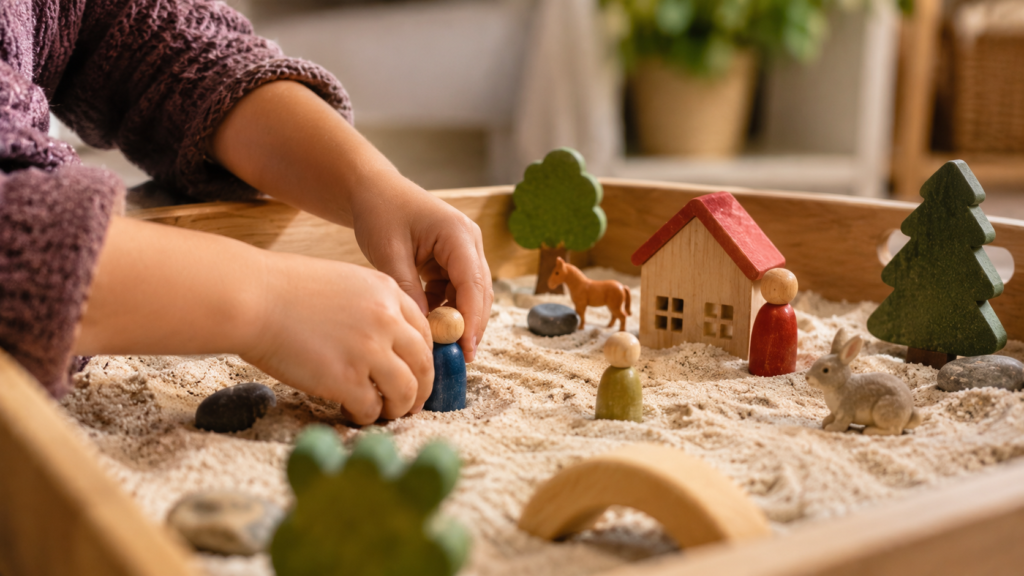
A cardboard box can become a spaceship. A collection of stones can become a family. A toy animal can be frightened, brave, lonely or powerful.
Children understand that these things are imaginary, yet the feelings experienced within the play can be very real.
Winnicott believed this space was important for emotional development, creativity and the emerging sense of self.
It allows children to explore possibilities without the same consequences or demands they might experience in everyday life.
We can see this in ordinary childhood play.
Children rehearse situations, experiment with relationships, explore being powerful or powerless, and imagine what might happen if things were different.
Sometimes they return to the same game repeatedly, not necessarily because they are stuck, but because repetition can be enjoyable, familiar or provide an opportunity to explore something further.
In play therapy, this imaginative space becomes part of the therapeutic work.
The therapist brings psychological understanding and clinical skill to a form of communication that is already familiar to the child.
Rather than requiring a child to translate everything into adult language, the therapy makes use of the child’s natural way of exploring their world.
The connection between play and emotional security
Attachment theory, developed by John Bowlby and further explored through the work of Mary Ainsworth, helps us understand why relationships are so central to children’s development.
Children need experiences of safety, responsiveness and emotional availability from the important adults in their lives.
These relationships provide a foundation from which they can explore the world and return for comfort when things become difficult.
Play has an important role here.
When we join children in something they enjoy, we are doing more than keeping them entertained. We’re sharing their interests, responding to their ideas and creating an experience of being together.
And there is a difference between being physically present and being emotionally available.
Most parents know what it’s like to be in the same room as their child while mentally working through the endless list of things that need doing.
Work, dinner, school lunches, washing, appointments. There is always something.
Play asks us to shift our attention, even briefly, away from what needs to be done and towards what’s happening in front of us.
That shared attention can strengthen connection.
It also gives children opportunities to experience manageable frustration, cooperation, enjoyment and emotional support within a relationship.
Over time, these everyday interactions contribute to emotional development and the ability to manage feelings.
We don’t need to turn every game into a lesson about emotions. In fact, doing so can take away from the experience.
Sometimes the value lies simply in enjoying each other’s company.
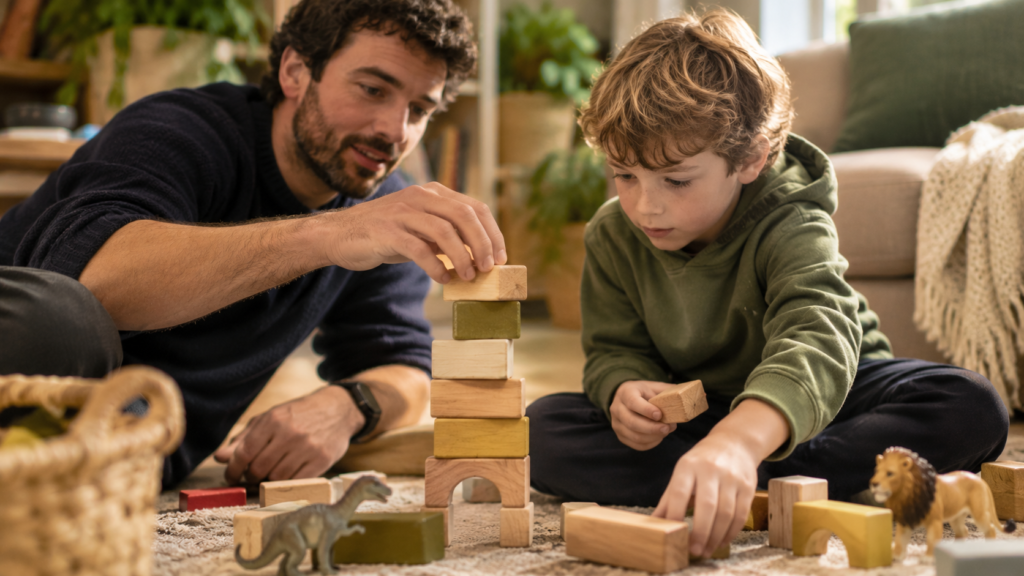
Have we started to undervalue play?
It’s worth considering how much children’s lives have changed.
For many families, the week is structured around school, homework, activities, appointments and the practical demands of family life.
Even play can become organised around achieving something.
We encourage educational games, activities that develop particular skills and experiences that will help children learn.
These things can be valuable, but they are not the only reason children need to play.
Unstructured, imaginative play offers something different.
It allows children to be creative without having to produce something, experiment without worrying about getting it right and enjoy an activity without an adult deciding what the outcome should be.
There is increasing pressure on children to perform, achieve and develop skills from an early age.
Perhaps we need to be careful that we don’t lose sight of the value of experiences that have no measurable outcome.
Play doesn’t have to be productive to be worthwhile.
And connection doesn’t always need a conversation.
Sometimes it happens while building Lego, making up a story, drawing together or laughing at something completely ridiculous.
Those moments may seem ordinary, but they are part of how relationships develop.
When play becomes therapy
While everyday play is important for all children, play therapy offers something more specific.
Children may experience emotional difficulties for many reasons, including anxiety, grief, family separation, changes at home, difficulties in school or challenges in their relationships.
At times, their distress may be difficult to understand or express.
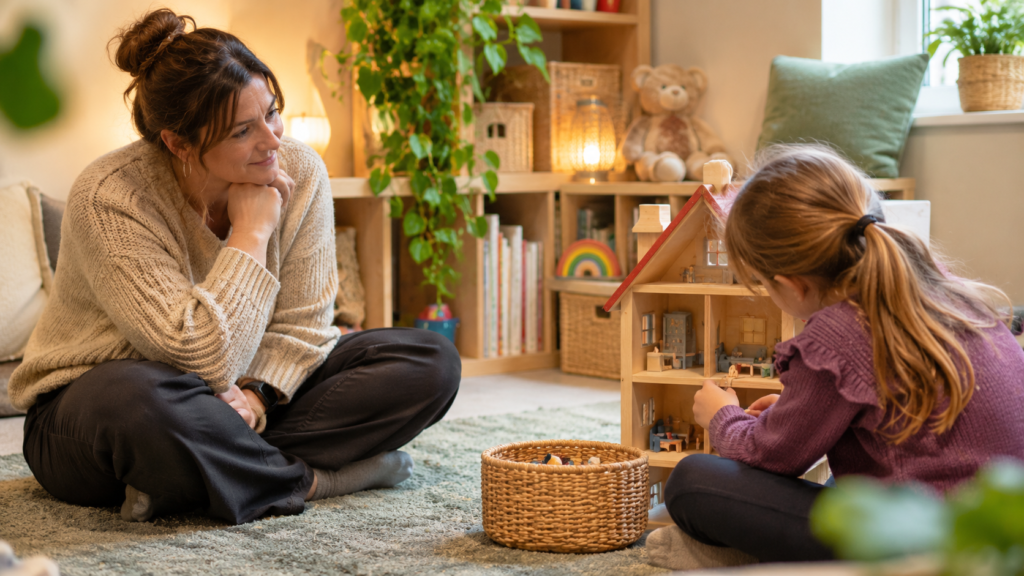
Play therapy provides a structured therapeutic setting where children can explore these experiences with a trained professional.
In child-centred, non-directive play therapy, the therapist uses the therapeutic relationship, play materials and an understanding of child development to support emotional expression and psychological growth.
The work is not about analysing every toy or trying to uncover a hidden message.
Nor is it simply an opportunity for a child to play while an adult watches.
The therapist is attentive to the child’s communication, emotional responses and developing understanding, using clinically informed responses to support the therapeutic process.
Parents also have an important role. Understanding the child’s wider experiences and relationships helps inform the work, while the child’s therapeutic space is respected.
Play therapy isn’t intended to replace the security and support children receive at home. It provides an additional relationship and setting where emotional difficulties can be explored in a developmentally appropriate way.
Learning to listen differently
Perhaps one of the difficulties we face as adults is that we’ve become so accustomed to communicating through words that we can overlook other forms of expression.
When we sense that something is wrong, we naturally want children to tell us.
We want to know what happened, what they’re thinking and what we can do to help.
But understanding children doesn’t always begin with getting an explanation.
It can begin with noticing what interests them, recognising changes in their behaviour, spending time together and being curious about their experiences without assuming we already know what they mean.
This doesn’t require us to analyse their play or turn ordinary family time into therapy.
It simply asks us to recognise that children’s emotional lives are complex, even when they cannot describe that complexity.
And that communication can take many forms.
The value of play is not that it gives adults a secret way to decode children’s thoughts. It’s that it allows children to explore and express themselves in ways that are natural to their stage of development.
For parents, that understanding can change how we approach connection.
We may still need conversations, reassurance, boundaries and guidance. Those things remain important.
But we can also make room for imagination, shared enjoyment and experiences that don’t need to be explained.
Play is connection. Play is their language.
And perhaps learning to understand children means recognising that listening involves more than hearing what they say.
Sometimes it means paying attention to what they show us.
Play Therapy at Summit Counselling and Psychotherapy
At Summit Counselling and Psychotherapy in Swords, we offer child-centred, non-directive play therapy for children aged 4–12.
Our play therapist, Bríd, supports children experiencing emotional and behavioural difficulties, anxiety, grief, family changes and challenges in their relationships.
We begin with a parent consultation to understand your concerns and explore whether play therapy may be an appropriate support for your child.
If you’d like to learn more about our play therapy service, you can contact Summit Counselling and Psychotherapy in Swords, North County Dublin.