
By Sean Adams, Accredited Psychotherapist, Summit Counselling and Psychotherapy Swords
If you’ve never been to counselling before, you’ve probably wondered what actually happens once you walk through the door.
It’s one of the questions I’m asked most often.
People tell me they’re worried they won’t know what to say. They’re afraid there will be awkward silences, or that I’ll ask a question they don’t know how to answer. Some think they need to have everything worked out before they come.
I completely understand those worries because I had them too. Before I became a psychotherapist, I was a client.
Watch the video
I thought my counsellor would fix me
When I first started counselling, I thought my counsellor would tell me what was wrong with me.
I imagined they’d explain why I felt the way I did and then give me the answer. Maybe they’d point out what I couldn’t see and tell me what I needed to change.
Instead, something much quieter happened.
My counsellor listened.
They were curious.
They asked questions.
They gave me space to think.
At first, I wasn’t sure what was happening. Looking back now, I realise they weren’t trying to solve my problems. They were helping me understand myself well enough to find my own way through them.
That was far more valuable than simply being given advice.
Can you ask me a question to get me started?
There’s one moment I still remember clearly.
I was sitting there thinking, I honestly don’t know where to begin.
Eventually I just said, “Can you ask me a question to get me started?”
My counsellor smiled and asked something simple. I can’t even remember the exact question now. It was probably something like, “How has your week been?” or “What’s been on your mind?”
What I do remember is what happened afterwards.
One thought led to another. Then another. Before long, I was talking about something completely different from what I’d expected.

That’s something I often think about when new clients come to see me.
People sometimes apologise because they don’t know where to start.
The truth is, that’s completely normal.
You don’t need to arrive with a plan. We simply start wherever you are that day.
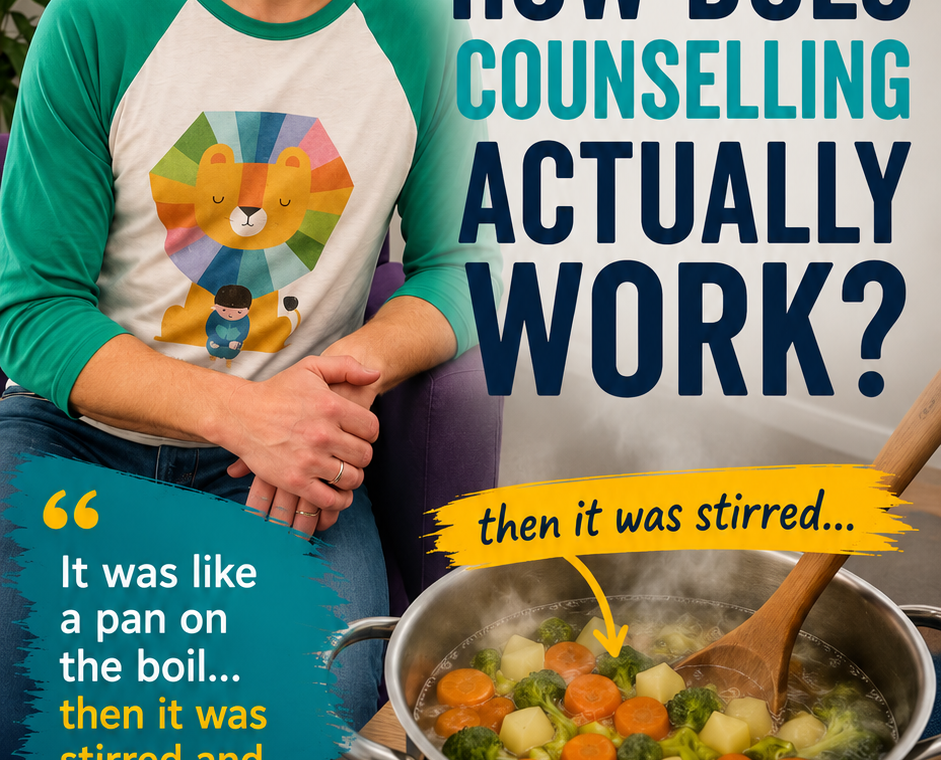
A pan on the boil
There’s an analogy I often use because it’s the closest I’ve come to describing what counselling felt like for me.
Imagine a saucepan on the hob. Inside are carrots, potatoes, broccoli and onions, all bubbling away together.
You know everything is in there, but while it’s boiling, it’s difficult to tell one thing from another.

Life can feel like that.
Stress from work mixes with relationship worries. Grief gets tangled up with anxiety. Old experiences quietly influence what’s happening today, and before long everything feels like one overwhelming mess.
Counselling didn’t magically take any of those things away.
It simply slowed everything down enough for me to see what I was carrying.
I could recognise what belonged to anxiety, what belonged to grief, what came from fear, and what was simply the result of being exhausted.
Once I could separate those experiences, they became much easier to understand.

Nothing had disappeared.
But it no longer felt like I was carrying everything at once.
So what does a counsellor actually do?
Looking back now, I can see that my counsellor wasn’t trying to steer the conversation or give me solutions.
They were paying attention to things I couldn’t yet see. Sometimes they reflected something I’d just said. Sometimes they asked a question that helped me look at something from a different angle. Sometimes they simply sat with me while I made sense of what I was feeling.
That’s still how I think about counselling today.
I don’t believe my job is to tell someone how to live their life.
I believe my job is to create the kind of relationship where people feel safe enough to become curious about themselves. Very often, when that happens, people begin finding answers that already existed within them but had been buried beneath stress, fear or self-doubt.
There isn't a right way to do counselling
No two counselling sessions are the same because no two people are the same.
Some people talk for the whole fifty minutes.
Some need a little time to settle before they begin.
Some cry. Some laugh. Some spend a session talking about something they didn’t expect to mention when they walked in.
It’s all part of the process.
You don’t need to prepare.
You don’t need to have the right words.
You just need to be willing to start.
Thinking about counselling?
If you’ve been thinking about counselling but have been putting it off because you’re worried you won’t know what to say, I hope this has helped make it feel a little less unknown.
In my experience, counselling isn’t about having all the answers.
It’s about having somewhere safe to begin asking the questions.
At Summit Counselling and Psychotherapy Swords, we support adults, couples, children and young people experiencing anxiety, depression, grief, trauma, relationship difficulties, stress and emotional overwhelm.
We offer a free 50-minute consultation so you can meet a counsellor, ask any questions you have and see whether we’re the right fit for you. There’s no pressure to continue it’s simply an opportunity to experience what counselling feels like and decide what feels right for you.
About the author
Sean Adams is an Accredited Psychotherapist and founder of Summit Counselling and Psychotherapy Swords. He works with adults and couples using a person-centred approach, believing that people are the experts in their own lives. His role is to walk alongside clients with curiosity, compassion and honesty as they find their own way.